
Hero

AI and Facilities for Frontier Science

We build and operate the cyberinfrastructure behind the largest scientific instruments, and we are making it a place where AI agents can work, trusted to help run the facility and able to carry a physicist's analysis from question to result.
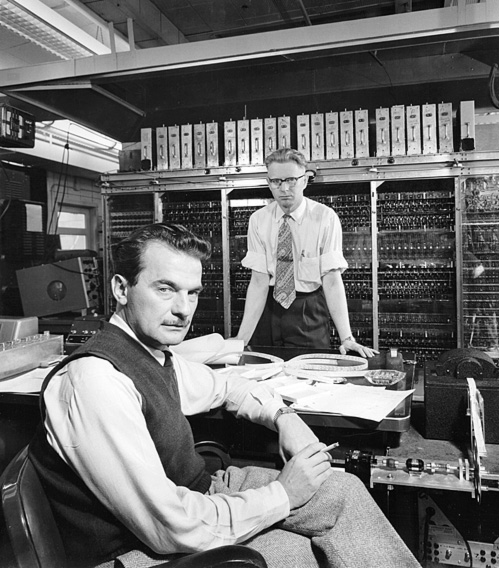
Nicholas Metropolis seated and chief engineer Jim Richardson standing beside the MANIAC I computer at Los Alamos Scientific Laboratory, early 1950s
Nicholas Metropolis (seated) and chief engineer Jim Richardson with the MANIAC I at Los Alamos Scientific Laboratory, early 1950s. Photo courtesy Los Alamos National Laboratory.
The MANIAC Lab team standing together in the Michelson Center for Physics, September 2025
MANIAC Lab at the Michelson Center for Physics, September 2025

Our name comes from Nicholas Metropolis (SB’36, PhD’41). At Los Alamos he led the team that built the MANIAC I, operational in 1952, and he later said he had chosen its acronym, Mathematical Analyzer, Numerical Integrator, and Computer, in the hope of ending the fashion for such names. In 1957 he returned to Chicago as founding director of the Institute for Computer Research, where the solid-state MANIAC III ran from 1961 at the University’s new Computation Center on Ellis Avenue.

We like the lineage. The MANIAC I ran the first Monte Carlo calculations, the method that still underpins every LHC simulation, and the MANIAC III was a machine built by physicists so that physicists could compute. That is still the job.


An ATLAS collision event display, the Analysis Facility at UChicago logo, and a rendering of the ATLAS detector

How We Work

Models and runtimes change by the month. The facility layer, its context, identity, trust and packaging, is ours to own, and it is where agents become useful and safe.

The facility layer

We run the Analysis Facility at UChicago, the Midwest Tier2 Center and the RP1 research platform, and host the IRIS-HEP Scalable Systems Laboratory. We write the facility down once, its storage, schedulers, data and identity, so every agent inherits it.

Facilities and platforms →

AI acting on the facility

Shannon governs agents that help operate the infrastructure. A trust ladder from observe to operate, promotion by evaluation, runbooks and policies reviewed as pull requests. AI proposes, experts decide.

Governance and operations agents →

AI acting through the facility

Physicists plug their own agents into one credential-brokered MCP gateway. Agents speak intent, not backends, so playbooks port across facilities, and a shared marketplace carries the know-how.

Gateway, playbooks, marketplace →

Collaborating with the MANIAC Lab

We work with researchers and scientific collaborations at every scale and at any institution.

Contact Us